Introduction to the NVIDIA AI Ecosystem
- NVIDIA provides a full-stack platform for AI training, inference, and end-to-end acceleration
- In real-world environments, NVIDIA tools reduce:
- training time
- inference latency
- GPU costs (through better utilization)
- operational complexity (drivers, dependencies, scheduling)
- The ecosystem is built for production environments such as:
- LLM API services
- multimodal applications
- edge/latency-sensitive workloads
- enterprise-scale ML pipelines
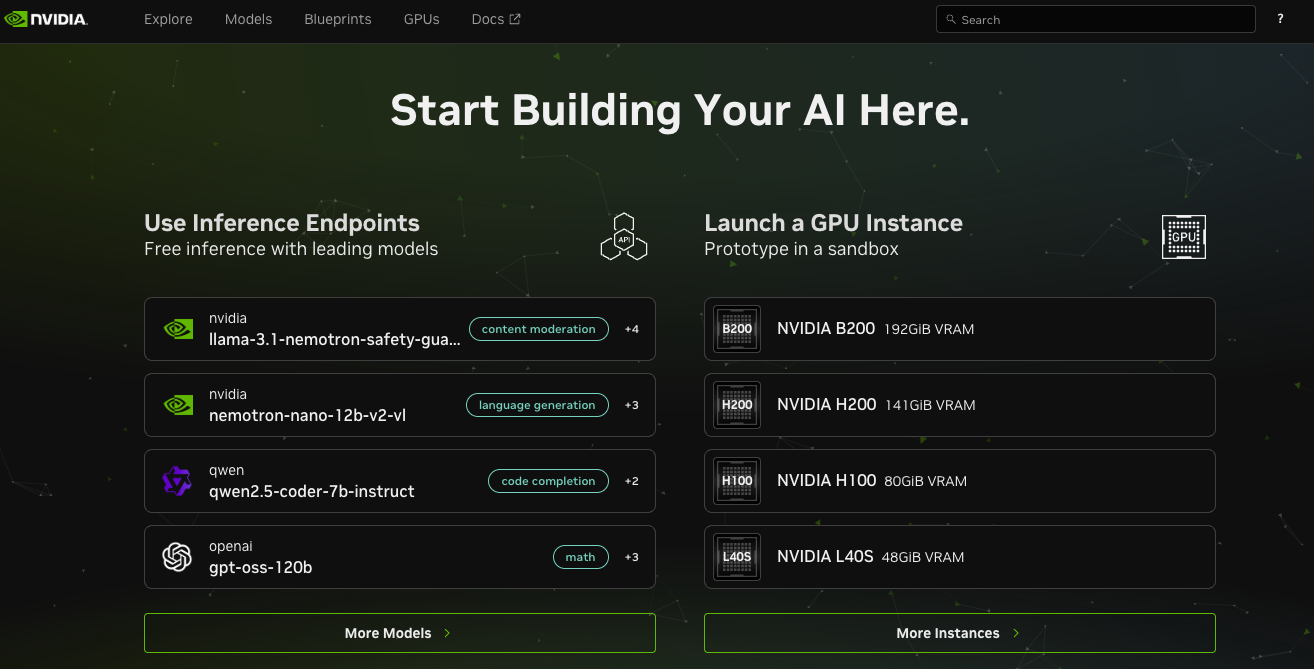 NVIDIA AI Ecosystem, Ref. build.nvidia.com
NVIDIA GPU Hardware for AI
- NVIDIA GPUs accelerate the tensor operations required for deep learning
- In practice, each GPU family maps to specific use cases:
| GPU Model | Key Characteristics | When to Use | Typical Workloads |
|---|---|---|---|
| H100 / H200 | Hyperscaler-grade GPUs for massive-scale AI | - Training 70B–400B LLMs - High-QPS inference with continuous batching - Multi-node distributed training (NVLink / NVSwitch) - DGX clusters or cloud GPU pods |
- Training frontier LLMs - High-throughput LLM serving (TensorRT-LLM, vLLM) - Enterprise-scale distributed training |
| A100 | Extremely versatile for both training & inference | - Fine-tuning Llama-3/7B–70B - Vision foundation models - Cost-efficient production ML workflows |
- Batch inference pipelines - Vision & multimodal models - General-purpose ML workloads |
| L40 / L40S | Strong balance of training and inference performance | - Image/video models (diffusion, ViT, generative models) - Medium-scale LLM inference - On-prem enterprise GPU servers |
- SDXL / diffusion models - 7B–13B LLM inference - Multimodal pipelines |
| RTX 4000 / RTX 6000 Ada | Workstation and edge-friendly high-performance GPUs | - Edge AI clusters - On-prem inference nodes - Developer workstations |
- 7B–13B LLM inference (q4/q8) - SDXL image generation - RAG/embeddings pipelines |
| RTX 6000 Pro Blackwell Server Edition | Inference-only Blackwell architecture optimized for efficiency | - LLM API serving with FP4/FP8 - High-concurrency token generation - Low-power inference clusters |
- Cost-optimized LLM serving - 24/7 production APIs - Large distributed inference fleets |
CUDA Platform
- CUDA provides the execution layer for all GPU-accelerated workloads
- Why it's practical:
- Every major ML framework (PyTorch, TensorFlow, JAX) compiles down to CUDA kernels
- Custom operations (FlashAttention, RoPE kernels, CUDA Graphs) rely on CUDA
- Production inference frameworks (TensorRT, vLLM, Triton) require CUDA support
- CUDA version management is critical:
- Mismatched CUDA ↔ driver versions lead to runtime failures
- GPU Operator simplifies this in Kubernetes

TensorRT and Inference Optimization
- TensorRT is commonly used to optimize and deploy models in production
- Real-world benefits:
- Up to 2×–6× throughput improvements
- Reduced GPU memory usage
- Lower latency → better user experience
- Practical examples:
- Quantizing FP16 → FP8 or FP4 for LLMs
- Fusing attention kernels
- Converting PyTorch models to ONNX → TensorRT for deployment
- Used heavily in:
- self-hosted chatbots
- diffusion pipelines
- streaming / real-time inference
- enterprise GPU inference clusters

NVIDIA Triton Inference Server
- Production inference server used widely across cloud/edge
- Practical reasons teams adopt it:
- One server supports multiple frameworks (PT, TF, ONNX, TensorRT, vLLM)
- Built-in dynamic batching increases throughput automatically
- Model versioning simplifies CI/CD
- Ensemble models can combine preprocessing → model → postprocessing
 NVIDIA Triton Inference Server, Ref. https://www.nvidia.com/en-us/ai/dynamo-triton/
Typical Triton deployment patterns
- REST / gRPC endpoints for online inference
- Autoscaled Kubernetes deployments
- Multi-model serving (LLM + embedding + reranker on same GPU)
- Token streaming for LLM inference (via TensorRT-LLM or vLLM backend)
NVIDIA NIM
- NIM provides ready-to-deploy microservices for:
- embedding models
- Llama-family LLMs
- document parsing / OCR
- vision models
- Benefits for engineering teams:
- No manual environment setup
- Standardized, versioned container images
- Works well for trial, PoC, or hybrid-cloud integration
GPU Management in Kubernetes
GPU Operator
- Automates installation of:
- NVIDIA drivers
- CUDA libraries
- container runtime integration
- DCGM monitoring agents
- Essential for stable production clusters
Device Plugin
- Exposes GPU resources to the scheduler
- Required for:
- GPU sharing
- MIG partitions
- guaranteed resource allocation
DCGM Exporter
- Monitoring agent for:
- GPU utilization
- memory usage
- power consumption
- temperature
- Integrated with Prometheus → Grafana dashboards
- Detects early performance issues (thermal throttling, OOM, underutilization)
Why the NVIDIA Ecosystem Matters
- Provides an end-to-end production stack from hardware → runtime → model server
- Reduces engineering overhead:
- no manual driver installs
- no dependency conflicts
- no custom distributed training kernels
- Enables practical workloads:
- real-time LLM serving
- high-throughput batch inference
- multimodal systems
- RAG pipelines
- enterprise-ready ML services
In short:
NVIDIA delivers a stable, optimized, and battle-tested platform for real-world AI training and inference.