Data Pipelines and the ML Workflow
What Are Data Pipelines?
Data pipelines are automated systems that move data across stages — collecting, transforming, enriching, and delivering it to downstream systems such as ML models, analytics engines, or storage layers.
- Key Characteristics
- Ingestion – Logs, events, databases, APIs, sensors
- Transformation – Cleaning, normalization, enrichment
- Routing – Moving data to warehouses, feature stores, ML systems
- Automation – Scheduled or real-time workflows
- Scalability – Handles massive, heterogeneous datasets
The End-to-End ML Workflow
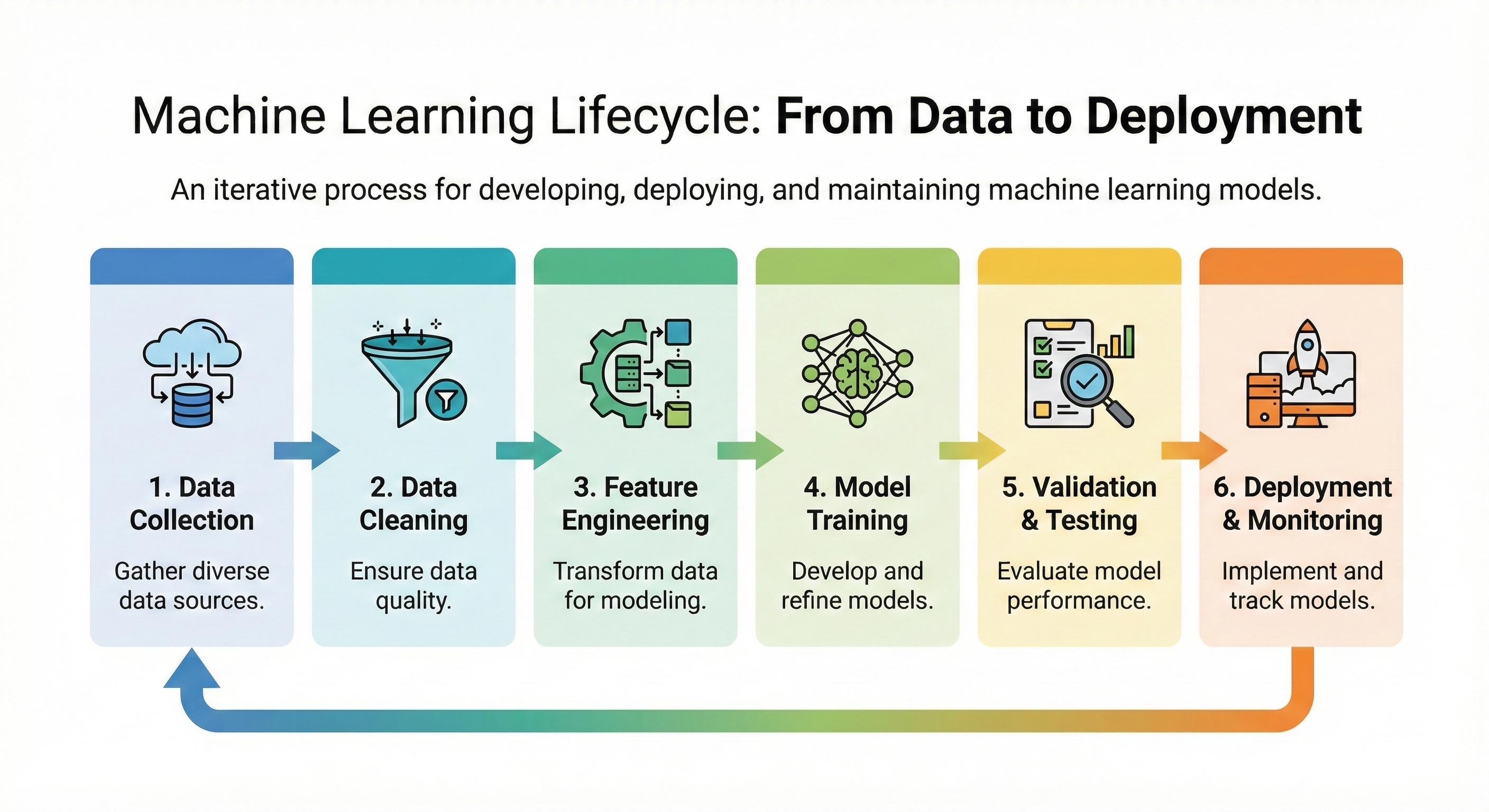
- They connect the entire lifecycle:
Data Sources → Feature Store → Model Training → Deployment → Monitoring → Retraining
Where This Applies in Modern AI Systems
- This workflow supports:
- LLM training and fine-tuning
- Recommendation engines
- Fraud and anomaly detection
- Predictive maintenance
- Real-time inference applications
- Retrieval-Augmented Generation (RAG) pipelines